
What’s New
This page brings together the latest news, events, and outputs related to the project and its broader theme.
Project Updates:
Upcoming webinar:
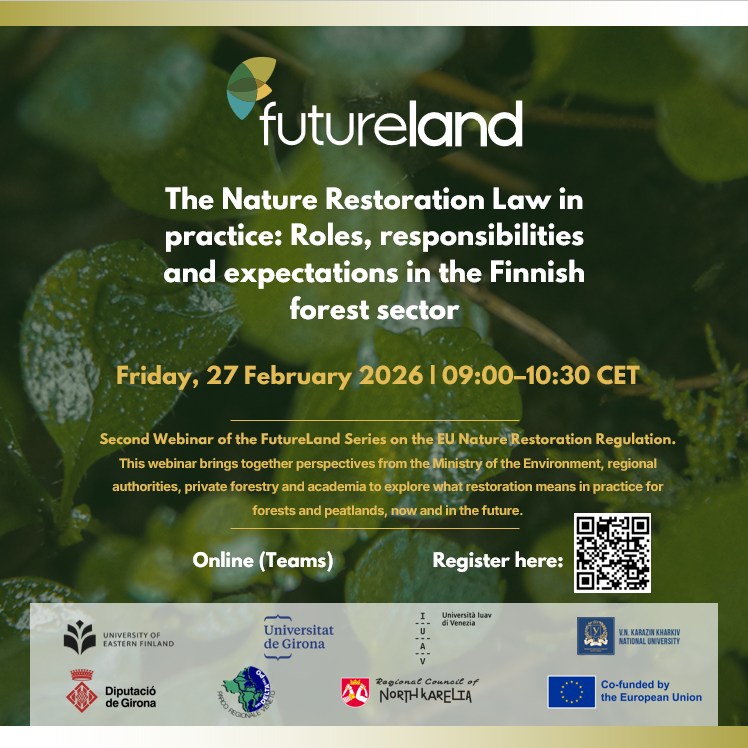
To participate, please register here: https://go.uef.fi/futurelandwebinar2
External News and Resources:
February 2026: FutureLand News & NRL Updates
Highlight 1: EU Biodiversity Assessment: “Implementation Must Now Accelerate”
On February 12, EC published its most recent assessment of the EU Biodiversity Strategy. While it recognizes that a sound legal framework via the NRL is now in place, the report also notes that Member States must implement their NRL’s much faster if they are to reach the 2030 targets. Commissioner Jessika Roswall noted that “restoration is the foundation upon which Europe will build its prosperity, resilience and security”, also focusing on soil health and water management. For the FutureLand project, this indicates a heightened urgency for us to distribute our Project Planning materials. The Commission is turning its attention from policy development to evidence of delivery. This report will serve as a formal “nudge” for Member States to establish their (NRPs with a high rate of ambition.
Highlight 2: Finance & insurance for Nature-based Solutions — NATURANCE Festival (3–5 Feb 2026)
- During the annual NATURANCE Finance Innovation Festival held in Brussels from 3rd to 5th February, stakeholders such as insurers, investors, policymakers and practitioners of nature-based solutions (NbS) gathered together to discuss how finance and associated instruments for transferring risk can generate scale in terms of funding nature-positive investments. The discussions incorporated a wide range of topics from innovative insurance programs to protect against risk arising out of an ecosystem approach to new models for derisking investments that support ecosystem restoration at a landscape level. Ultimately, the festival revealed practical takeaways for implementing NRLs: 1) Restoration projects require dependable financing sources; 2) There are a variety of instruments that can support financing for long term ecosystem projects; and 3) These financial tools should meet the resiliency of the ecosystem against climate change.
The festival highlighted the importance of coordination between public and private partners, the importance of standards and monitoring for unlocking access to capital, and the need to integrate restoration planning into investable pipeline; in essence, a critical bridge between national plans for restoration and the funding available in the marketplace to implement these plans. (NATURANCE)
Highlight 3: New Technical Guidance for Ambitious National Restoration Plans
The technical roadmap that EEB and its partners have produced, was created to aid ministries and other stakeholders that are currently developing their NRPs. It examines common issues each of these countries’ experiences, such as identifying Favorable Reference Areas and delineating priority zones that are outside of areas designated as Natura 2000, or protection areas under EU law. The guidance provides assistance in the development of plans which are based on science, are inclusive, and legally compliant, by providing a process for doing so. FutureLand is providing practical assistance to its stakeholders through this report; assistance is derived from the fact that the report provides a foundation from which to assist with transitioning from the theoretical aspect of law to practical world application.
Highlight 4: Launch of the Updated NRP Preparation Tool and Technical Manual
Highlight 5: Roadmap for a unified European biodiversity monitoring system (EBOCC / EBVs)
In February, a roadmap was published by some researchers that aims to create a coordinated network of observation across Europe. This would be based on 84 different essential biodiversity variables (EBVs). This work is linked to the European Biodiversity Observation Coordination Centre (EBOCC), which is still in its preparation phase. The objective of this coordination and use of observational data is to provide comparable and policy relevant trend analyses and restoration outcomes for biodiversity based on all forms of biodiverse data collected (i.e. remote sensing, in-situ, and Genetic monitoring) across all countries involved. This roadmap will provide the technical blueprint for, and a political rationale for investment in, continental-data infrastructure that supports both national and EU-level accountability and supports the NRL delivery. The Regulation relies on robust and interoperable monitoring systems to monitor restoration progress, verify restoration outcomes, and support adaptive management.
Highlight 6:
- As of February 3, 2026, the European Commission has completed its first officially approved Carbon Removal and Carbon Farming (CRCF) Regulation certification methodology. This event indicates the movement from simply developing this policy to being “in operation”. These methodologies will help to clarify what constitutes high-quality tons of permanent carbon removal for technologies such as direct air capture (DAC) and bioenergy with carbon capture and storage (BECCS).
The meaningfulness of these methodologies for the Nature Restoration Law is that they provide the “financial plumbing” necessary for attracting private investment in the restoration of natural ecosystems. The issuance of clear and definitive guidance on the permanence and liability of removed carbon will give businesses and landowners the certainty needed to support large-scale investments in restoration. The first EU-certified restoration projects are anticipated to begin within the next few months because of these methodologies.
January 2026:
Highlight 1: Nature Restoration Regulation — Reference portal (European Commission)
The Commission Reference Portal is a one-stop shop for all implementation, technical and guidance documents related to the Nature Restoration Regulation. Articles are categorized based on different themes, such as Urban Ecosystems (Article 8) and include a range of resources to support the implementation of the regulation by Member States when developing their National Restoration Plans, including examples of methodological support, frequently asked questions (FAQs), and links to various datasets and tools. It is also an official point of contact for the Commission where all interpretive guidance, informal consultation papers and links to EU platforms (Urban Nature Platform) will be located in order to support our WP5 Monitoring activities. Through the portal, the Commission communicates its expectations for timing, monitoring and key data requirements with Member States and provides access to evolving technical guidance as they seek to develop and evaluate their national plans.
Highlight 2: Funding the Green Transition
The European Commission has announced that the year 2026 will be the ‘Implementation Year’ of the Nature Restoration Law and has set the 1st September 2026 as the deadline for EU member states to submit their National Restoration Plans (NRPs). A key part of the announcement was the allocation of approximately €350 million through the LIFE program to support the development of NRPs across Europe with technical assistance. This will be very relevant for our leaders of WP5 as NRPs must specifically address how Cities in the EU will reach a ‘no net loss’ of urban green space (UGS) by 2030. This announcement prioritizes funding projects that combine Biodiversity Restoration with Climate Adaptation, thus, giving regional authorities a clear pathway to access this funding to reshape their Urban Environments.
Highlight 3: The Policy Debate — A “Make-or-Break” Year
BirdLife International is sharing a report from a European perspective that assesses some of the political issues that will be vital with respect to a proposed Regulation on Nature Restoration (NRL) over the coming years (until the end of 2026). This report will highlight important issues now being debated in relation to the “implementation gap” between EU mandated minimum standards, and national preparation for implementing the NRL. In light of the enactment of this NRL, it is clear that while all Member States will be required to abide by the juridical decisions within the NRL, there is a great deal of variation in how all of the Member States draft their own NRPs. The BirdLife report highlights the substantial debate currently occurring between the industrial sector and the environmental sector over what land uses should receive priority as outlined in their proposed projects. This analytical piece is of special relevance to the FutureLand project because it calls for increased public engagement in the construction of NRPs and the necessity of scientific verification of the projects being proposed by both local authorities and governmental bodies across the EU.
Highlight 4: Technical Focus — Standardizing the “Green” Metric
Monitoring is part of this technical update, and it includes the “how”. In 2026, The European Union will begin using a standardized report format so that the progress made in restoring the environment can be measured consistently and accurately. Through the EEA indicators and satellite imagery, urban areas will be required to prove that they have fulfilled their obligations for city greening by providing objective evidence regarding their compliance with the European Union’s Urban Greening Program. Using GIS and Information Technologies for Areal Management will be key to meeting these requirements for cities and municipalities. For us at Karazin University, this resource is a diamond in the rough because it links our students’ technical studies directly to the legal requirements of the NRL. There is more than just planting a park; there is geospatial data that shows the park is functioning as a resilient urban ecosystem.
Highlight 5: “Cropped – 14 January 2026: Wildfires, EU trade, and nature in 2026” – Carbon Brief (brief news analysis)
Carbon Brief’s Mid-January wrap-up covers the most significant “landscape events” (e.g. Wildfires and other phenomena) that demonstrate the importance of Nature Restoration as a component of climate Resilience. The article reiterates the NRR’s objectives (to restore 20% of European Union land/sea by 2030 and all ecosystems depending upon restoration by 2050) and emphasizes the necessity for NRPs to be adopted as a means of immediate national action as of 2026. It ties together restoration, food production systems, and trade and indicates that agencies will need to coordinate their activities throughout the policy spectrum (i.e. Agriculture, Water, Forest Management and Urban Planning) to implement successful strategies. This document could be of great value when promoting Restoration, to depict how Restoration is really cross-sectoral (industries), and to demonstrate that Stakeholder Engagement (Farmers/Cities/Water Managers) will be the key to effective delivery of successful National Restoration Plans.
Highlight 6: “Ukraine introduces special legal regime for protection of peatlands” , UNDP Ukraine (5 Jan 2026)
There is a recent report on the UNDP Ukraine Project, indicating national authorities have prepared a draft of a special legal regime for peatland to establish a unified domestic approach to peatland protection that matches EU best practices and international agreements (e.g., Ramsar). The draft is part of a larger initiative to establish a legal framework that can facilitate the transposition of EU environmental legislation into Ukraine’s national legislation, as well as support the restoration of peatland and mitigating greenhouse gas emissions from drained peat soils. The information contained in this report is a unique example of a current development occurring at the national level within Ukraine that corresponds with the NRL and addresses one of the key areas of focus for EU law, peatland restoration targets. Therefore, this report provides a solid opportunity to demonstrate national progress while bridging the gap between EU guidance and the work of local legislators.